Dead After Dinner
Dead After Dinner is a card-based murder-mystery story game for 3-5 people. It was written by Jenn Martin and takes 1-2 hours to play.
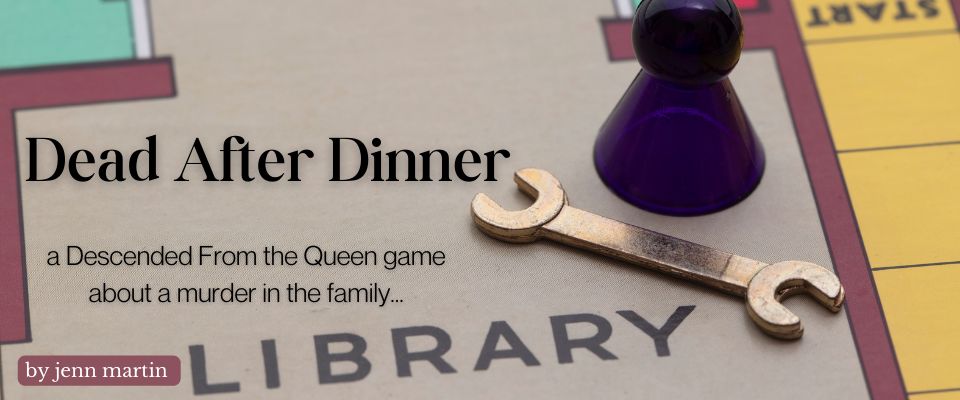
The patriarch of a dysfunctional family has uncharacteristically invited his family to dinner. He has told everyone that he has changed his will, and will read it after dinner…
Dead After Dinner is available as a deck of cards or a pdf download. You can also play it online here, which is what I did with two friends. It took us about an hour to play.
What is a story game?
A story game is a tabletop game where the primary focus is creating and influencing a narrative. Players control plot outcomes through decisions, often resulting in high replayability.
(And to make clear, this isn’t a murder mystery. At the start of the game, we don’t know who the murderer will be, but we will decide this as the game progresses. There’s no puzzle to solve; the nature of the killer comes out in the narrative. It’s lots of fun.)
In Dead After Dinner, a deck of cards is placed on the table, and each player draws a single card from the deck. They read the prompt aloud from the card and answer the questions, adjusting the narrative accordingly. Other players may ask questions for further details. Then the next player draws a card, and so on.
The first few cards of Deck After Dinner are the instructions, followed by the meat of the game.
How Dead After Dinner works
Dead After Dinner is played in phases. To prepare each phase, you add cards to the deck according to how many players you have.
(Note – the online version is set up for four players, and can’t be changed. We didn’t realise this until afterwards. If you’re playing with three or five players, you will get some odd results.)
Resentment: Before I get into the game, I need to mention Resentment, a numerical score that starts at 1 and fluctuates depending on the cards drawn.
Characters
There are eight characters, including children, spouses (and an ex-spouse), and grandchildren. Most of the characters have a question that needs answering and a Resentment modifier.
For example, the eldest child is the CEO of the Patriarch’s company (when did he name you CEO?), and as a result, loses one Resentment.
I was the middle child (+1 Resentment), and I decided my name was Emily.
During this phase we fleshed out the family in general – we decided that we were in Australia, and that the Patriarch had made his money in property. And we gave him a name: Dougal Montague.
Dinner
Then we get to the serious business of dinner, when relationships and resentments will deepen. During this phase, each character will draw two cards, such as:
What valuable object does the Patriarch give you at dinner? Does he do so subtly, or loudly? Who is obviously jealous? Choose: subtract 1 from your Resentment, or ask the jealous character to add 1 to theirs.
During this round, I discovered I was the black sheep of the family, but also that I was living in the much-coveted guest house.
Dessert and the new will
Dessert is just a single card: The Patriarch complains of a headache and retires to his bed – meanwhile, one player can choose to read the will without the Patriarch being present. If they do, they gain 1 Resentment!
(So of course I read the will in advance!)
Then we find out the details of the new will, each player drawing one card. For example:
Who inherits the house? Why is that disappointing to you?
Murder!
With the will read, we discover that the Patriarch has been murdered. There are five different murder cards, and in ours, he was discovered next to a bottle of his favourite liquor.
The Detective and Questioning
With the Patriarch dead, the police arrive, and a detective starts questioning the family. Again, each player draws two cards.
For example, one of mine was: Didn't you take a call during dessert? Why can't anyone confirm where you were? Add 1 to your Resentment. (Why yes, officer, I did. I had to take a call from the babysitter, and I wanted to take it privately, so I stepped into the library, away from where anyone could overhear.)
At the end of all this, I had the highest Resentment of the three of us, with 8.
Whodunnit?
With the questioning over, it’s time to decide who murdered the Patriarch!
With the final card drawn, each player in turn does one of the following:
- Claim innocence (you must do this if your Resentment is negative – that wasn’t a problem for us)
- Admit to being an accessory
- Narrate how you are exposed as the murderer
- Narrate how you get away with murder
I decided that I was the murderer, exposed by a hidden kitchen webcam (which I didn’t know about), which revealed me poisoning the ice bucket that my father used for his drink.
We then finished off with a character epilogue, showing what our characters were doing later in life. (Rotting in jail, in my case.)
Overall
We had a lot of fun, with plenty of laughing. We created terrible, awful characters, the game giving us enough structure to create a good narrative. (I can imagine it being useful as a writing tool.)
We played it online with three players – I suspect it would be much more fun in person with four or five players.
So overall, I recommend trying Dead After Dinner. The pdf is inexpensive (but will need a little crafting to turn into a deck of cards), but you can try it for free. Much as I would like to recommend the print-on-demand set, the postage to the UK was much too expensive for me.
Click here to learn more about Dead After Dinner.

I’m Steve Hatherley, an experienced designer of interactive
murder mystery games, creating and hosting them since the 1990s. I co-founded
Freeform Games and Great Murder Mystery Games to bring this distinctive,
character-driven style of game to a wider audience. My work—including Death on
the Gambia, Hollywood Lies, and
—has been enjoyed by thousands
of players worldwide. I’ve also written a book sharing my approach to creating
immersive, freeform mystery experiences.
Recent Articles


-
Secret Tribe - a review of a jubensha murder mystery
Sep 21, 26 09:14 AM
-
221B Baker Street: The Master Detective Game review
Aug 19, 26 09:24 AM
-
A Fatal Theory - a science lab murder mystery for 8-12 players
Aug 19, 26 04:58 AM
-
Top five murder mystery party kits for newbies
Jun 05, 26 09:36 AM
New game
A Fatal Theory - a modern science murder mystery for 8-12 players
Don't know where to start?
Here's my suggested quick route through the site:
Step 1 - Go to Choosing a Game to choose the game that suits your party best.
Step 2 - Review the Tips for Hosts for helpful advice.
Step 3 - If you want to keep up to date with the latest murder mystery game news, subscribe to my newsletter.
Step 4 - Once you've had your party - tell me how it went! Click here to tell me your murder mystery party story.
Got a question? Click here to go to the FAQ.